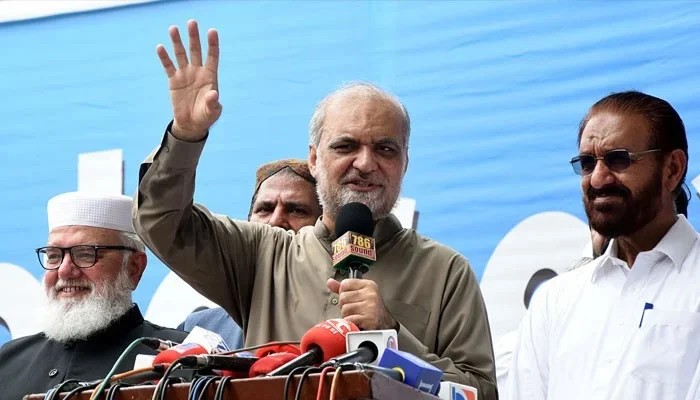
Jamaat-i-Islami chief Hafiz Naeemur Rehman has announced a march on Islamabad on September 20 to protest the Petroleum Development Levy (PDL), warning the government that the party's campaign will enter a "decisive phase" if the levy is not withdrawn before the demonstration. Addressing a rally in Gujranwala on Friday, Rehman said caravans from across Pakistan would head towards the federal capital and urged the government to respond to growing public anger.
"If the petroleum levy remains in place when the march begins, the people will decide the matter on the streets of Islamabad," he said, warning that failure to address public demands would push the party towards a campaign aimed at bringing down the government. The federal government currently imposes Rs114 per litre in taxes and duties on petrol and Rs100 per litre on diesel. The announcement came as Jamaat-e-Islami sit-ins against the levy entered their 27th day in Lahore, Peshawar, Karachi and dozens of other locations.
Rehman said the protests would be expanded and announced that he would address a women's gathering in Islamabad on Saturday. Earlier, he chaired a meeting of Jamaat-e-Islami leaders from across the country at Mansoorah in Lahore to discuss the next stage of the protest campaign. Rehman portrayed the Jamaat-e-Islami as an emerging political force and said the party had become a source of hope for people frustrated with successive governments.
He accused the country's bureaucracy, feudal landlords and powerful families of dominating the political and economic system, saying ordinary workers were bearing the brunt while children were being pushed into labour and denied access to education. The Jamaat-e-Islami chief also criticised the Punjab government over violence and exploitation against women. He claimed around 6,500 cases had been registered in the province but said convictions had been secured in only a small number of them.
Rehman challenged Punjab Chief Minister Maryam Nawaz to submit a complete account of her income and expenditure to the Federal Board of Revenue after her recent comments that she had paid for a London trip on a government aircraft herself. He also accused the Sharif and Zardari families of contributing to the exploitation of the poor and claimed that more than 40% of Punjab's population was living in poverty.
Turning to the petroleum levy, Rehman claimed the government had collected Rs1,567 billion from the public through the charge. He questioned the rationale for imposing what he called a "jagga tax" when millions of Pakistanis still lacked adequate access to healthcare and education. He also criticised successive governments since the 1990s for policies that, he said, benefited independent power producers, arguing that authorities should reduce their own expenditures rather than impose additional taxes on citizens.
Rehman questioned the federal government's continued budget allocations for departments and functions after the 18th Amendment transferred several powers to the provinces. He also called for an end to interest-based financial practices, citing a ruling by the Federal Shariat Court. He argued that even a partial reduction in interest payments could save the national exchequer thousands of billions of rupees.
The Jamaat-e-Islami leader said the party had raised these issues during talks with the government but had received no satisfactory answers. "If the rulers cannot answer the people's questions, the people will now demand answers themselves," he concluded.