
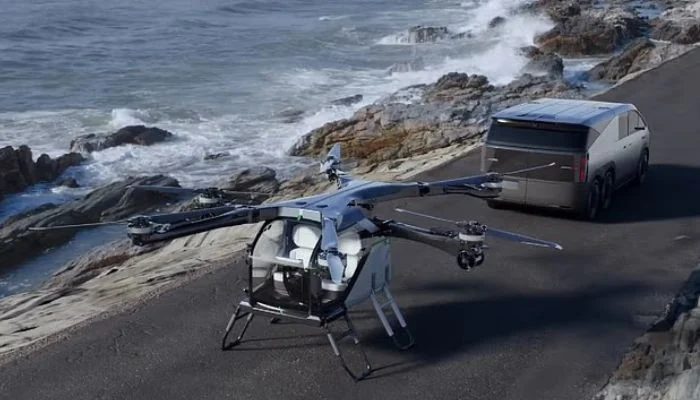
A Chinese electric vehicle manufacturer is set to launch a two-seater flying car in 2027 that can fly autonomously and reach heights of up to 1,000 metres. Developed by Aridge, the aviation arm of Chinese electric vehicle manufacturer XPeng, the $300,000 flying car is expected to begin limited operations in the second half of 2027.
The aircraft comes with a six-wheeled vehicle, roughly the size of a delivery van, which carries the flying machine in its rear compartment. Once deployed, the two-seat aircraft takes off vertically using six battery-powered propellers, resembling a large drone rather than a conventional car.
It can be controlled using a joystick or programmed to fly autonomously to a designated destination. The aircraft has a flight range of approximately 30 kilometres, although the company hopes to double that distance through improvements in battery technology.
Speaking at the Web Summit in Lisbon, Aridge chief executive Deli Zhao claimed the aircraft was so simple to operate that he could teach someone to fly it in just five minutes. However, those hoping to escape traffic jams by flying over crowded cities may be disappointed.
The aircraft will initially operate only in approved recreational areas and for emergency services, while broader urban use remains restricted. The company has received more than 7,000 pre-orders worldwide, with most coming from China and some from the Middle East.
Chinese aviation regulators have authorised limited testing, but the aircraft still requires final certification before wider commercial operations. XPeng is also exploring opportunities in the United Arab Emirates, Southeast Asia and Europe as China pushes to develop its growing low-altitude aviation industry.
Industry experts suggest that while the technology is groundbreaking, the regulatory framework for urban air mobility remains the biggest hurdle. Safety protocols and air traffic management systems must evolve significantly before these vehicles can share the skies with commercial aircraft.
Furthermore, the infrastructure required for such vehicles, including designated landing pads and charging stations, is still in the conceptual phase. Cities will need to redesign urban planning to accommodate vertical take-off and landing (VTOL) zones.
Despite these challenges, the excitement surrounding the project is palpable. Investors are closely watching the progress of XPeng as it attempts to bridge the gap between science fiction and reality in the transportation sector.
As the 2027 deadline approaches, the global aviation community remains focused on whether this innovation will truly revolutionize personal travel or remain a niche luxury for the wealthy.