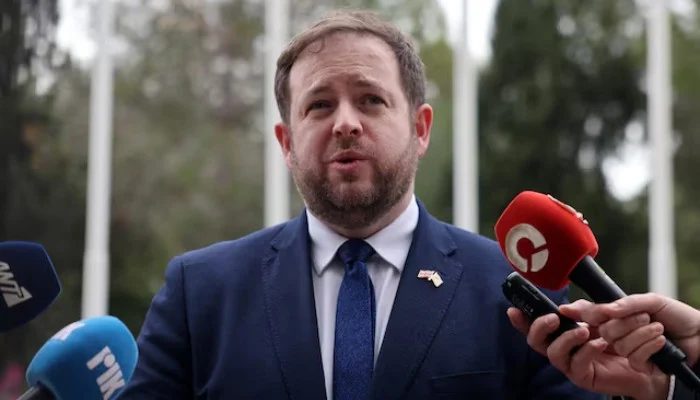
British Minister of State Stephen Doughty announced an additional £300,000 for transnational education in Pakistan, and said Britain wants to expand educational partnerships between British and Pakistani institutions. He said the two countries have deep historical and people-to-people ties, important trade and commercial links, and close work on security and foreign-policy priorities.
On education, he said Britain was "incredibly proud" of its education system and recognised the value placed on British education in Pakistan. He welcomed existing collaborations, including Cardiff Metropolitan University, and said both sides want to take the cooperation much further.
"We want to see up to 100 UK universities working with institutions across Pakistan, equipping young people with skills and opportunities for the future," he said. He said the cooperation would benefit both countries and open the way for research collaboration.
He said students should gain international experience and learn from different cultures, countries and education systems. "In my own experience, and having studied internationally myself, the very best learning comes when it's on a global scale," he said.
He said educational and research cooperation could help both countries face artificial intelligence, climate change, the energy transition, healthcare and pharmaceuticals. Turning to Afghanistan, he said education is central to Britain's concerns, in particular the denial of education to Afghan women and girls.
"We do not have diplomatic relations with the Taliban regime," he said, adding that Britain was "deeply shocked and appalled" by recent attacks on Pakistan from terrorist groups. "It's crucial that Afghanistan is peaceful, is stable," he said.
He said Britain is particularly concerned that women and girls in Afghanistan are denied basic education. "We urge, of course, the regime there to open up education," he said.
He warned that denying education to half the population deprives women and girls of opportunities and damages the country's future. He said women had played a crucial role in the Afghan health sector in the past and are now denied the chance to contribute.
"I very much hope for a different future for Afghanistan," he said. Asked whether the international community could push the Taliban to change policy, he said the Taliban authorities themselves must take the necessary steps.
He said Britain supports international organisations through its aid and development programmes and works with non-governmental organisations and other partners. "We all want to see a peaceful, stable, and secure future for Afghanistan and its people," he said.