
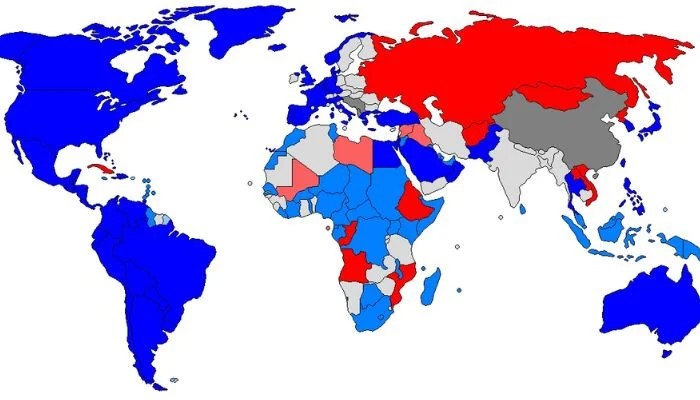
For nearly 35 years, the architecture built after 1991 - American primacy, a web of alliances, a rules-based trading system, and a United Nations meant to arbitrate disputes among great powers - held, however imperfectly. In 2026, that architecture looks like a system under strain and more like one in active collapse. War has engulfed Israel, the US, and Iran. Russia and Ukraine remain locked in their fifth year of fighting even as peace envoys shuttle between Moscow and Kyiv. Washington and Beijing are fighting a tariff war that has repeatedly threatened global auto chains. BRICS, now an 11-member bloc, convenes this weekend (September 12-13, 2026) in New Delhi. And the UN, marking its 80th anniversary this year, is nearly broke. But beneath these crises sits a pattern getting too little attention: nobody is bothering to reform the old institutions anymore. They are building parallel ones instead.
Rather than one dramatic rupture, 2026 looks like the year the post-Cold War order got forked. And the clearest evidence sits, of all places, in the White House. Starting with Iran, what began as Israeli strikes on Iranian nuclear sites in June 2025 escalated into direct U.S. bombing and a fragile ceasefire. They didn't just bomb Iranian facilities; they killed the head of state himself, along with his defense minister Aziz Nasirzadeh, the Revolutionary Guard commander, and the secretary of Iran's Security Council, Ali Larijani, in coordinated strikes. That is a qualitatively different act from the deterrence-based standoffs that defined Cold War and post-Cold War power behavior, where leadership decapitation of a state actor was treated as an unthinkable escalation.
The aftermath highlights the order's enforcement gap more than the strike itself. Hezbollah dragged Lebanon into a war that has killed more than 4,000 people and displaced over a million, and Houthi strikes on Saudi Arabia wounded 73 people last week, indicating that a strike aimed at ending Iran's regional network instead diffused the conflict across four additional countries, with no multilateral body able to contain the spillover.
Moreover, succession mattered less than the U.S. may have hoped, as Iran stood up an interim leadership council within a day and moved to a new supreme leader rather than collapsing, meaning the "decapitation equals regime change" theory underlying the strike hasn't been validated. The same substitution of raw force for institutional process shows up in Ukraine, just conducted through diplomacy rather than munitions.
What's analytically striking about the current round of shuttle diplomacy isn't that talks are happening - they have happened repeatedly since 2022 - but that they are happening without any multilateral institution driving them. Envoys Witkoff and Kushner spent over three hours with Putin on September 6, then went straight to Kyiv - a bilateral, personality-driven process running entirely outside the UN, the OSCE, and any treaty framework built for exactly this purpose.
Putin has reportedly told associates he won't negotiate seriously until Russia holds the rest of Donbas, meaning the diplomacy is tracking the battlefield rather than shaping it. This is a reversal of how the postwar order was supposed to function, where institutions were meant to constrain territorial conquest, not ratify it after the fact. Civilian casualties in Ukraine rose 31% in 2025 vs. 2024, as per the UN Human Rights Monitoring Mission in Ukraine.