
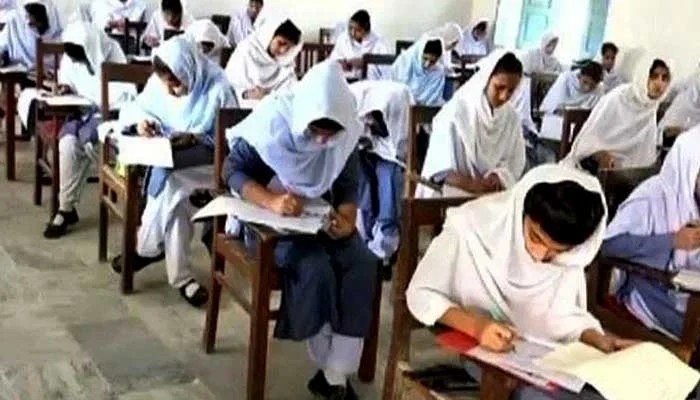
Last week, all nine Boards of Intermediate and Secondary Education (BISEs) in Punjab released Class 9 results. This year's headline numbers are a provincial pass rate of 46 per cent - most students failed Class 9. Failure at a grade level is defined as failing in one (or more) subject by scoring less than 33 per cent (an abysmally low bar) in an exam or practical. Broken down by gender, the pass rates for girls and boys this year are reported at around 58 and 35 per cent, respectively. By public and private schools, pass rates in Lahore BISE, the largest in Punjab, are 39 and 70 per cent, respectively. Similarly, for Faisalabad BISE, the pass rate breaks 45 and 73 per cent for public and private schools, respectively.
Across almost all districts of Punjab, private schools have outperformed public schools by margins of 24-32 per cent. Save for Rawalpindi and Bahawalpur, where the pass rate fell by 8.0 and 6.0 per cent year-over-year, respectively, it held just about steady everywhere else. Thus, the great tragedy of the Class 9 results is not that of a widespread sharp decline. The tragedy is that after all the proclamations of education reforms of the last few years - the Single National Curriculum (SNC), later deftly rebranded as the National Curriculum of Pakistan (NCP), the Daanish Schools being established at an unsustainable per-student cost, the public-private partnership programme for public schools - nothing has budged, nothing has changed. Last year's Class 9 pass rate in Punjab was 48 per cent, virtually indistinguishable from this year's 46 per cent.
According to the Annual School Census (2024-25) of public schools in Punjab (not including private schools following the public school curriculum), the attrition rates in enrollment numbers going from Class 8 to Class 10 are brutal: around a 12.5 per cent drop out between Class 8 and Class 9, and another 20 per cent of Class 9 students do not make it to Class 10. Most shocking of all, 89 per cent of Class 10 / Matric public school students do not make it to Class 11.
I am citing the figures for Punjab (because they are handy), but the situation is just as bad in other provinces. I write about the state of education in this country often, and I have run out of euphemisms for shame and failure. Before I get to some of the explanations being offered for this year's disappointing results, let me underline a lesson for our ministers that can be drawn from this long-running disappointment: Please, do not make too much noise and draw attention to yourself and your portfolio if you are not serious about putting in the effort and are just out to raise your social media profile.
Publicity stunts and grand proclamations get you in the headlines but, inevitably, some people start watching your work to make sure you follow through, and that usually ends in a pants-on-fire situation. And so it is this time as well. Early reactions to the release of Class 9 results were congratulatory messages to select (read: cherry-picked) schools that had performed well. Then, as public reaction to the poor statistics started pouring out, the honourable minister of education attached a threatening message to those congratulatory messages: Teachers and administrators of schools that performed poorly will be taken to task. A little later still, a new spin on things: The low pass / high fail rate was actually a good thing - it was a result of a crackdown on the cheating mafia.